By Asif Zaman Rizvi
“Children are the future of our nation; they are the living embodiment of India’s dreams.”
— Pandit Jawaharlal Nehru
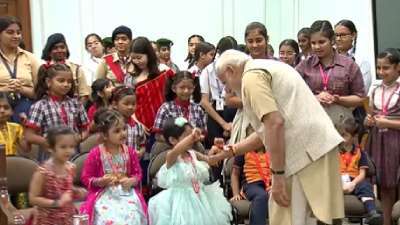
The future of a nation is not written in its parliaments, but in those classrooms where children learn to translate dreams into words. When a child’s laughter turns into confidence, the nation’s face begins to smile. This is the picture of today’s India — where under the visionary leadership of Prime Minister Narendra Modi and Chief Minister Yogi Adityanath, child welfare has moved beyond the realm of mere government policy and evolved into a people’s movement for an empowered society. This smiling childhood is the living symbol of an empowered India — the truest reflection of a nation in bloom.
At the heart of Prime Minister Modi’s governance lies his conviction that children and youth are the driving force of a developed India. His vision is clear — “To make India a developed nation, we must empower the dreams of its children.” It is from this belief that the National Education Policy 2020 was born — the first such reform in 34 years — transforming the roots of India’s education system. The focus has shifted from rote learning to creative thinking, from memorization to imagination. From pre-primary to higher education, the emphasis is now on holistic development and joyful learning.
Complementing this intellectual reform is a revolution in health and nutrition. The POSHAN Abhiyaan and the Pradhan Mantri Poshan Shakti Nirman Yojana have improved the lives of millions of children. In 2018, India’s under-five malnutrition rate stood at 35%, which dropped to 32% as per NFHS-5 (2021). These are not mere statistics, but a reflection of intent, integrity, and humane governance.
In Uttar Pradesh, Chief Minister Yogi Adityanath has placed child welfare at the core of state policy. Once considered lagging behind in education, Uttar Pradesh now leads the nation through the NIPUN Bharat Mission, under which 1.9 crore children have been trained in foundational literacy and numeracy, and 1.6 lakh teachers have received specialized training.
The Yogi government has also merged technology with education. More than 1.5 lakh smart classrooms have been established, and 1.3 crore students now have access to digital learning materials. Under the School Chalo Abhiyan, 27 lakh tablets and smart devices have been distributed, enhancing both learning outcomes and students’ self-esteem. Education in government schools is no longer seen as an obligation but as an opportunity.
Today’s child is no longer confined to textbooks. The Atal Tinkering Labs (ATLs) have ignited a culture of innovation across rural and urban schools alike. Over 10,000 ATLs have been established nationwide, including 700 in Uttar Pradesh, where children are experimenting with robotics, 3D printing, and coding. Prime Minister Modi once said, “Children are not just the future — they are the inspiration of India.” These labs give that thought tangible form, nurturing problem-solvers and creators. Now, even children in the remotest villages are becoming the torchbearers of “Made-in-India Innovation.”
India’s fight against malnutrition has reached a decisive turning point. Under the Pradhan Mantri Poshan Shakti Nirman Yojana, nutritious meals are served daily to 11.8 crore children, including 1.8 crore in Uttar Pradesh. Through the centralized kitchen system, in partnership with organizations like the Akshaya Patra Foundation, the quality and transparency of meals have been ensured.
The Mukhyamantri Suposhan Abhiyaan has extended nutritional support to pregnant women and infants. With 1.89 lakh Anganwadi Centres functioning across villages, millions of children now receive food, vaccination, and early education every day — a seamless blend of care, compassion, and commitment.
Child safety has also witnessed a historic transformation. Initiatives like Operation Smile and Operation Mukti have reunited over 16,000 missing children with their families. Moreover, One Stop Centres, Child Protection Units, and Childline Services have created a safety net for vulnerable children, especially girls. The POCSO Act and Integrated Child Protection Schemes under the Modi government beautifully combine policy with sensitivity. Today, India sends a message of hope to the world — “A safe childhood is the foundation of a secure nation.”
The Beti Bachao, Beti Padhao campaign has changed societal attitudes. The India that once believed “boys learn, girls manage homes” now celebrates equality in classrooms. In Uttar Pradesh, the Gender Parity Index (GPI) in school enrolment stands at 1.06 — meaning girls now outnumber boys in schools. Scholarship programs, bicycle distribution schemes, uniforms, and the Kanya Sumangala Yojana have collectively strengthened girls’ confidence and independence. This is the transformation once envisioned by Nehru through Children’s Day, now realized through the governance of Modi and Yogi.
The Digital Revolution has liberated education from boundaries. Platforms such as PM eVIDYA, DIKSHA, and SWAYAM have enabled millions of children to learn online. During the pandemic, when the world’s classrooms fell silent, India ensured learning continuity through technology. The Yogi government’s initiative to establish Wi-Fi-enabled schools in rural areas bridged the digital divide. Now, children from villages access e-content, video lectures, and interactive learning on par with global standards — a revolution not just in technology, but in equal opportunity.
Both Prime Minister Modi and Chief Minister Yogi Adityanath have envisioned education not merely as a means to employment but as a path to character-building. Schools have reintroduced yoga, meditation, moral education, and patriotic songs, reviving the spiritual and ethical dimensions of learning. Children are now taught not just how to pass exams, but how to prepare for life. Uttar Pradesh’s model of “education with values” has turned learning into a moral journey — where education’s ultimate goal is not livelihood, but life-worthiness.
When India completes a hundred years of independence, these very children will be the architects of a Viksit Bharat — Vision@2047. Both the Modi and Yogi governments are investing in that future — in education, nutrition, health, and skill development — ensuring that no child is left behind.
The Mukhyamantri Bal Seva Yojana stands as a symbol of compassion for those orphaned by the COVID-19 pandemic, offering them monthly assistance, education, and shelter. It is governance not by numbers, but by empathy — rule not written in statistics, but in tears wiped away.
Children’s Day is not merely an occasion; it is a solemn pledge that each generation owes to the next. The Modi–Yogi era has fulfilled this responsibility with both policy and purpose. Education has given knowledge, protection has ensured dignity, and nutrition has restored vitality.
Today’s India glows with the confidence of its children — secure, spirited, and self-assured. From village to city, from son to daughter, every child now shares the same opportunity. This is the true essence of democracy — when the smile of every child reflects the confidence of a nation.
A smiling childhood is the most beautiful portrait of an empowered India — and this radiant harmony of innocence and strength is the true identity of the Modi–Yogi era.