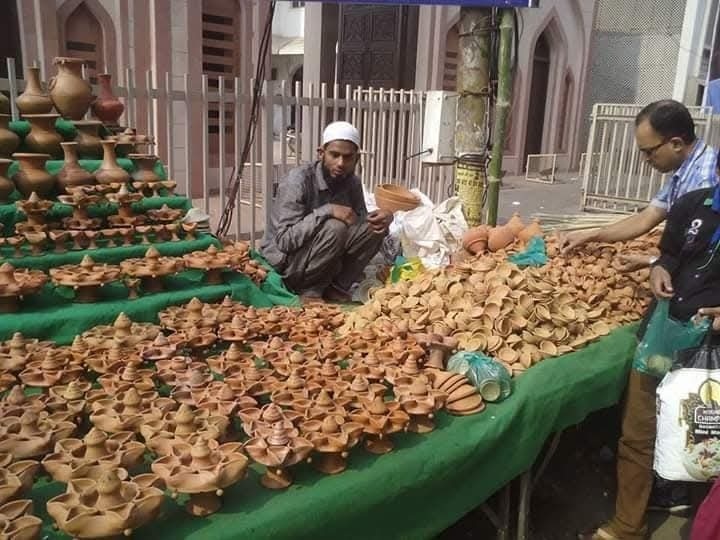
Photo courtesy : Ali Hasan
Asif Zaman Rizvi
Diwali in India is not just a festival of lights; it is a living tapestry of culture, craftsmanship, and communal harmony—a luminous thread that has bound the nation’s soul for centuries. The brilliance of a Diya illuminates hearts, but it also reflects the tireless dedication of artisans whose hands transform raw clay into vessels of light. Their fingers draw brilliance from earth and fire, spreading radiance into every home. In these hands, religion forms no barrier—for light belongs to all.
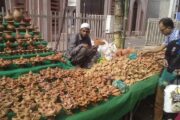
Nowhere is this shared spirit more visible than in Uttar Pradesh. In every district, generations of artisans craft clay lamps, mold figurines, paint intricate patterns, and breathe life into Diwali markets. Cities and towns like Lucknow, Ayodhya, Azamgarh, Mau, Bhadohi, Firozabad, and Moradabad are home to thousands of Muslim families whose livelihoods revolve around this seasonal economy. This partnership across communities is the essence of India’s social harmony, the Ganga-Jamuni Tehzeeb, sparkling in every home along the state’s streets and alleys.
Since 2017, Uttar Pradesh has elevated this cultural consciousness to new heights. When Chief Minister Yogi Adityanath inaugurated the Diwali festival in Ayodhya, few could have imagined it becoming a world-class celebration of heritage. Last year (2024), 2.512 million lamps illuminated the ghats; this year (2025), the government aims for 2.8 million lamps. This extraordinary spectacle on the Sarayu riverbank promises not only spiritual brilliance but also economic light for thousands of local artisan families.
For the villages surrounding Ayodhya, the demand for clay lamps during Diwali is more than seasonal—it sustains families for the entire year. The government’s conscious decision to purchase lamps from local artisans has linked faith with employment in a visionary way. A significant portion of these artisans hail from Muslim families who have mastered their craft for generations. This is the true image of progress and harmony in Uttar Pradesh: a lamp crafted by a Muslim artisan illuminating a Hindu household, spreading light into both lives.
The combined vision of Prime Minister Narendra Modi and Chief Minister Yogi Adityanath has brought fresh recognition to traditional craftsmanship. The central government’s Pradhan Mantri Vishwakarma Scheme has created opportunities nationwide, providing artisans with training, toolkits, ₹15,000 in financial support, and low-interest loans. Millions have benefited, with Uttar Pradesh leading the initiative. Clay lamps, figurines, painting, and metalwork—all come under its purview, ensuring the survival and growth of traditional arts.
Further, the Ministry of Minority Affairs’ USTTAD Scheme (Upgrading Skills and Training in Traditional Arts for Development) focuses specifically on Muslim artisans, connecting traditional crafts with modern markets. Training camps across Uttar Pradesh have not only rejuvenated artistic skills but also equipped young artisans with digital marketing and e-commerce capabilities, expanding their reach beyond local markets.
State-level initiatives such as the Vishwakarma Shram Samman Scheme and One District One Product (ODOP) have helped artisans gain recognition and sustainability. In the past two years, over 143,000 artisans have received training, toolkits, and financial aid. By promoting clay, wood, metal, and terracotta products, the Yogi government has simultaneously strengthened local employment and preserved India’s rich artistic heritage.
Ayodhya’s Diwali festival has evolved into more than a cultural event—it is now an economic powerhouse. Estimates suggest that over 10,000 local artisans benefit directly or indirectly each year. From clay lamps to decorations, fabrics, flowers, lighting, and logistics, every sector sees the positive impact of this festival, creating a ripple effect across small traders and artisan families alike.
The spirit of Prime Minister Modi’s “Local for Vocal” and the Atmanirbhar Bharat campaign shines vividly at Ayodhya. When a Muslim artisan shapes a clay lamp on his wheel, destined to glow on the Sarayu ghats, he is shaping more than clay—he is shaping the soul of India itself.
Across Uttar Pradesh, in the bustling lanes of Lucknow’s Husainganj, the Firozabad bazaars, Moradabad’s utensil markets, and the streets of Azamgarh and Bhadohi, this shared culture thrives. Hindu traders and Muslim artisans work side by side, with no walls of religion—only bonds of trust, skill, and mutual respect. This is the India envisioned by Mahatma Gandhi, Pandit Nehru, and Sardar Patel, where faith and livelihood complement each other rather than compete.
The government has also ensured that artisans gain national and international exposure. ODOP products are marketed online, while platforms like Hunar Haat and Mission Shakti Bazaar give artisans visibility and sales opportunities. Muslim artisans’ participation in these fairs is increasing, symbolizing the inclusive vision of development and progress.
When Prime Minister Modi lights lamps in Ayodhya and Chief Minister Yogi stands amidst the sea of flickering lights on the Sarayu ghats, it is more than a ritual—it is a celebration of India’s shared heritage. It is a moment where policy, tradition, and livelihood converge, illuminating the path of a new Uttar Pradesh where faith and economy shine together.
Yet, the journey ahead demands improvements. Greater transparency, accessible data, and awareness among Muslim artisans are vital. Expanding common facility centers, enhancing digital training, and providing e-marketing opportunities can elevate this traditional art to global recognition.
In an era when the world grapples with divisions, Uttar Pradesh offers a luminous example: faith and employment can coexist in harmony. When a Muslim artisan molds clay and a Hindu family lights the lamp at their doorway, both illuminate each other’s existence. This is India’s true strength—the Uttar Pradesh of the Modi-Yogi era, where development, faith, and livelihood bask together in shared light.
Today, Ayodhya’s Diwali is no longer merely a symbol of Lord Ram’s victory—it represents a collective triumph, encompassing every faith, community, and artisan. In the glow of these lamps shines the sweat and skill of Muslim craftsmen, reinforcing the social fabric of India.
As we light our lamps this Diwali, let us remember—they are not mere symbols of worship, but tributes to the clay shaped by the hands of artisans. This is India, where clay, labor, and unity converge to create a radiance unbound by religion or boundaries. This is the Ganga-Jamuni Diwali, the true emblem of a new India.
Asif Zaman Rizvi